Trust Pharmacy – Delivery Times, Savings, and Safety Tips
By Michael H. Hotchkiss, MD
Medically Reviewed by Robert J. Holt, PharmD, MBA
Last Update: June 8, 2026
Contents:
People usually reach an online pharmacy for one clear reason: the price looks better than what they are used to paying. That first comparison matters, but it does not tell the whole story. A medication page can show a low number, while the final order depends on strength, quantity, coupon rules, shipping cost, and delivery time.
That is where Trust Pharmacy needs a closer look. The site brings product listings, discounts, payment choices, and shipping options into one ordering process, but the useful part is not the promise of savings alone. It is whether the details stay clear enough for a customer to understand what they are buying, what they will pay, and what to expect after checkout.
Trust Pharmacy Overview and Main Features
The service puts medicine listings, dosage choices, package sizes, prices, and delivery options into a single order path. The catalog does the early work: it shows what is available, how products are named, and where brand-name and generic choices begin to differ.
What the Online Service Offers
 Trust Pharmacy uses a catalog-style layout, closer to an online drugstore shelf than a telehealth app. The focus stays on the product listing: medicine name, strength, package size, and the steps that move the order toward checkout.
That format has a practical advantage. Someone who already knows what they are looking for can search quickly, open the listing, and compare available options without moving through a long intake process first. The experience is closer to browsing a pharmacy shelf than booking a medical visit.
The service has also moved far from the small-counter idea behind traditional in-store shopping. Instead of one local stockroom, the website presents a wider catalog for customers who want to compare medicines before placing an order. Safety checks, delivery, coupons, privacy, and support still need separate attention, but the starting point is the catalog itself.
Medication Categories and Common Treatments
 The catalog covers a wide mix of treatment areas people often look for online: men’s health, women’s health, hair loss, allergies, antibiotics, skin care, pain relief, heart health, blood pressure, diabetes support, and other routine medical needs. Many categories branch into strengths, package sizes, and brand or generic versions, so the same treatment area can lead to several buying choices.
Men’s health is usually one of the most searched areas, with products grouped around erectile dysfunction and hair loss. Women’s health may include fertility support, hormone-related medicines, infection care, and other common treatments. Skin care can include acne products, antifungal creams, and anti-inflammatory options, while allergy and infection categories may include tablets, nasal products, eye drops, or antibiotics depending on availability.
For repeat-use medicines, the category alone does not say enough. A blood pressure drug, diabetes product, or heart medication may appear in several strengths, and the pack size can change how the order looks once it reaches the cart. A buyer comparing routine medicines usually needs to check whether the listed dose matches the one prescribed, whether the quantity suits a monthly or longer supply, and whether the form is tablets, capsules, cream, gel, or another option.
The same issue appears with brand and generic naming. Some listings use the name people recognize from advertising or past prescriptions; others use the active ingredient. That can make the catalog more useful, but only when the buyer reads the listing closely instead of treating every similar name as the same medication.
Brand-Name and Generic Medication Options
Brand-name drugs usually arrive first, with the research costs, patent protection, marketing, and familiar packaging attached to them. Generic medicines come later, after the original protection period changes and other manufacturers can make versions using the same active ingredient. That is why the same treatment may appear under two very different names: one known from advertising or past prescriptions, the other tied to the ingredient itself.

The price difference is often the reason people look at generics first. Trust Pharmacy lists many lower-cost alternatives beside better-known brand names, and the gap can be large enough to change the cost of a full order. A generic version does not need the same brand campaign behind it, and manufacturers are often working with an established formula rather than launching a new drug from scratch. Lower production and marketing costs usually show up in the final price.
The important comparison is not the label alone. A generic should match the brand-name drug in active ingredient, strength, dosage form, and intended effect, though the color, shape, packaging, manufacturer, or inactive ingredients may differ. Sildenafil Citrate, for example, is the generic name often compared with Viagra. Tadalafil is the generic name often compared with Cialis. The brand may be more familiar, but the generic name is often where the lower price appears.
Generic options may also appear in more than one form or package size. Some products are sold as standard tablets, while others may appear as soft tablets, gels, chewable forms, capsules, creams, or larger packs, depending on the medicine. That variety can be useful, but it also makes careful reading more important. The best match is the one that lines up with the needed dose, form, quantity, and directions — not simply the one with the lowest number beside it.
Trust & Safety: Licenses, Standards and Customer Reviews
Safety in online ordering depends on more than a professional-looking website. The useful signals are licensing details, prescription rules, medication standards, customer feedback, and support access before a customer reaches checkout.
Licensing, Standards and Verification Details

Licensing details become especially important when an online pharmacy sells prescription medicine outside a familiar local setting or across borders. A serious provider should make its operating details easy to check: who runs it, what rules apply to prescription orders, how product quality is handled, and where a customer can turn if something looks wrong after the package arrives.
For Trust Pharmacy, the safer way to read this part is to look for verification signals rather than broad promises. A license number, company contact details, prescription policy, pharmacist access, medication source information, and written shipping or return terms all carry more weight than a simple claim that the store is “trusted” or “certified.” FDA’s BeSafeRx program also warns buyers to be careful with online pharmacies that skip prescriptions, lack proper licensing, offer prices that look too good to be true, or send medicine in damaged, foreign-language, expired, or unusual packaging.
The same caution applies to product standards. Generic medicines can be legitimate lower-cost options, but the listing should still show the active ingredient, strength, dosage form, manufacturer when available, and package details. If a site claims that a product is approved or made to a specific standard, the claim should be traceable to a regulator, manufacturer, or official product document rather than left as marketing language.
This verification becomes important when a low price is the first thing that attracts attention. Discounted medicine can still be legitimate, but the lower the price looks, the more important the surrounding details become: prescription handling, drug labeling, support access, delivery terms, and a way to confirm that the drugstore is operating under recognizable rules.
Customer Reviews and Service Reputation
Trust Pharmacy has a generally positive reputation among shoppers who focus on price, simple ordering, generic options, and discreet delivery. Recent customer feedback from 2024–2026 is most useful when it describes the full order path: product search, checkout, confirmation, shipment updates, and package arrival.
Outside sources such as Trustpilot, Sitejabber, Google Reviews, ResellerRatings, pharmacy forums, and complaint boards can help show whether that reputation holds beyond testimonials on the pharmacy’s own site. Positive comments often point to savings on repeat orders, access to generic medicines, discreet packaging, and support that answers when something needs checking.
Exact ratings should be used only after checking the current platform score. A strong review profile is not just a high number; it is a pattern of completed orders, fair pricing, reliable fulfillment, and support that responds. Occasional shipping delays can happen with online medication orders, but repeated recent complaints about missing tracking, damaged parcels, refund delays, or unanswered messages deserve caution.
What to Check Before Ordering
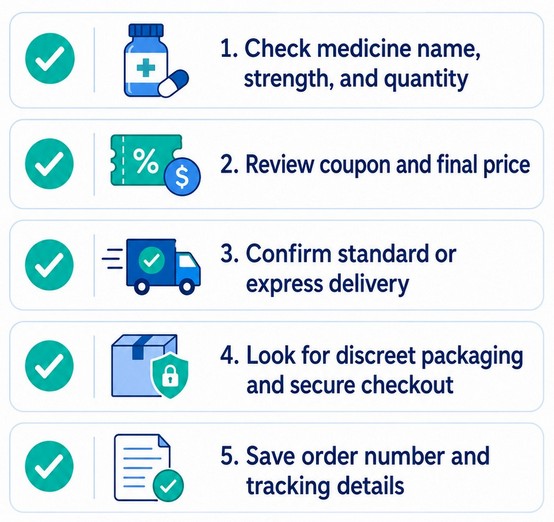 Before confirming the purchase, the product listing and the cart should match in every detail that can change the order: medicine name, active ingredient, strength, dosage form, package size, quantity, and price per pill. This is especially important when a catalog shows similar names close together, or when a medication appears in several forms such as tablets, capsules, creams, gels, or soft tablets. A buyer looking at a 30-tablet pack may also see 60, 90, or larger quantities nearby, and the lower price per pill can distract from whether the dose or supply length is actually right.
The prescription note belongs in the same check before payment. For prescription medicines, the listing should explain whether a prescription is required, how it is submitted, and whether the request can move forward before review. The cart then needs one final comparison: selected product, pack size, coupon, shipping method, delivery address, and total cost after fees. If the coupon disappears, the shipping method changes, the quantity is different, or the address format looks wrong, it is better to fix the order before checkout than rely on support after processing has already started.
How Online Ordering and Customer Support Work
Online ordering starts once the product choice is made. From there, the important parts are the cart, confirmation email, order status, and the support channels that handle questions before or after payment.
Website Search and Product Pages
The search bar is important because people rarely look for the same medicine in the same way. One person may type Viagra, another may type sildenafil, and another may search for “generic Viagra.” The same thing happens with Cialis and tadalafil, Levitra and vardenafil, Propecia and finasteride, or Clomid and clomiphene. A useful product search catches both the brand name and the active ingredient, then sends the customer to listings that can be compared side by side.
The product page is where the real sorting begins. A men’s health listing, for example, may show 25 mg, 50 mg, or 100 mg strengths, while a hair-loss treatment may come as 1 mg or 5 mg tablets depending on the medicine. Antibiotics, allergy treatments, skin creams, and blood pressure medicines can also appear in different strengths, forms, and package sizes. The title alone is not enough; the buyer needs to check the dose, form, quantity, and price per pill before treating two similar listings as equal.
Good medicationpages also reduce small but expensive mistakes. They should show whether the item is a brand-name drug or a generic version, what active ingredient is being sold, how many tablets, capsules, sachets, creams, or gels are included, and whether the medicine has any prescription note attached. Usage and side-effect summaries can help a customer recognize the product, but they should stay secondary to professional medical advice. At this stage, the job of the page is simple: make the selected medicine identifiable before it moves into the cart.
Cart Review and Checkout Steps
The cart is where a product listing turns into an order. It is also where small changes can appear: a coupon may lower the total, a shipping option may add cost, or a larger package may make the price per pill look better while raising the amount paid today.
A simple checkout check should cover five things:
- Product details — medicine name, active ingredient, strength, form, and package size.
- Quantity — number of tablets, capsules, tubes, gels, or packs in the order.
- Coupon — whether the code applies and whether the total actually changes.
- Delivery choice — shipping method, estimated time, and added cost.
- Personal details — address, email, phone number, and payment information.
The final total needs one more look after every change. If the coupon disappears, the delivery option switches, the quantity changes, or the address looks incomplete, it is better to fix the cart before payment. After the request is submitted, even a small mistake can take longer to correct.
Order Confirmation and Customer Support
 After checkout, the order confirmation becomes the first thing to check. A useful confirmation email shows the order number, selected products, quantity, recipient address, payment status, and any next step connected with prescription review or fulfillment. If it does not arrive, the customer should check the spam folder first, then contact support with the name, email used at checkout, and the approximate time the request was submitted.
Trust Pharmacy gives customers several ways to ask for help:
- Email — best for detailed questions, payment concerns, prescription notes, screenshots, or anything that needs a written record.
- Contact form — useful for general order problems, delivery questions, coupon issues, or checking the status of a request.
- Phone support — better for matters that need quicker clarification, especially if an order detail may need correction before shipping.
- FAQ section — helpful for basic questions about ordering, medication categories, payment, shipping, privacy, and common account issues.
Support is most useful when the first message includes the order number, product name, delivery address, and a short explanation of the problem. A missing confirmation, delayed package, coupon error, or stalled tracking update is easier to handle when the pharmacy receives exact purchase details instead of a vague complaint. During busy periods, replies may take longer, but a specific message usually gives support less to chase down.
What Brand and Generic Medications May Cost Online
Online medication prices can look simple until the order details are added. A product may show a low starting price, but the real comparison depends on the strength, pack size, brand or generic version, and dosage form. Coupons and shipping change the final total later, but the medicine price starts with the product details.
Trust Pharmacy is usually most attractive to buyers comparing generic versions with better-known brand-name medicines. Generic options often cost less because they are sold under the active ingredient name and do not carry the same brand marketing costs. For repeat-use medicines, even a small difference per tablet can matter once the buyer compares a 30-day supply with a larger pack.
The price gap is especially noticeable in categories where both brand-name and generic choices are common. Men’s health medicines, hair-loss treatments, antibiotics, allergy products, skin care medicines, and long-term maintenance drugs may appear in several strengths and quantities. A larger pack can lower the price per pill, while a smaller pack may be more reasonable for a first purchase or a treatment used only occasionally.
A better price check should include these details:
| Price Detail | What to Compare | Why It Changes the Cost |
|---|---|---|
| Brand or generic version | Check whether the medicine is listed by brand name or by active ingredient. | Generic versions often cost less when the active ingredient, strength, and form match the intended treatment. |
| Strength | Compare the listed dose, such as 25 mg, 50 mg, 100 mg, 1 mg, or 5 mg. | A lower price may belong to a different strength, so the dose needs to match before the price is compared. |
| Package size | Look at the number of tablets, capsules, tubes, gels, or packs included. | Larger quantities may lower the price per unit, but they also raise the amount paid at checkout. |
| Dosage form | Check whether the product is a tablet, capsule, cream, gel, soft tablet, chewable tablet, or another form. | Different forms can carry different prices, even when they appear in the same treatment category. |
| Supply length | Compare whether the order covers occasional use, a 30-day supply, or a longer refill cycle. | A small price difference per pill becomes more important across 30, 60, or 90 days. |
This approach gives a more honest picture than comparing one advertised price against another. A low-cost listing can be a good deal when the dose, quantity, form, and supply length all make sense together. If one of those details changes, the final value changes with it.
Standard and Express Shipping: Times, Tracking and Costs
Shipping is where the cheapest order can start to look different. Standard mail, express courier service, tracking quality, customs checks, and reshipment rules all affect what the customer actually gets after checkout.
Standard Airmail vs. Express Courier Delivery
Standard airmail and express courier delivery serve different buyers. Standard shipping usually makes sense when the purchase is not urgent and the customer wants to keep costs lower. Express service costs more, but it usually gives faster movement, better tracking, and fewer long gaps between updates.
| Delivery Option | Estimated Time | Tracking | Best For | Trade-Off |
|---|---|---|---|---|
| Standard Airmail | Usually about 14–21 days; some international orders may take longer during customs checks, holidays, or carrier delays. | Limited tracking in many cases. Updates may appear slowly or stop for several days while the package moves between postal systems. | Lower-cost orders, repeat medicines ordered early, and customers who are not in a hurry. | Cheaper, but slower. Timing is less exact, and tracking can be weaker. |
| Express Courier | Often about 3–8 business days after dispatch, depending on destination, carrier handling, and customs processing. | Usually stronger tracking, with more frequent scans and clearer movement from dispatch to arrival. | Time-sensitive orders, higher-value purchases, or customers who want closer package visibility. | Faster and easier to follow, but the shipping fee is higher. |
Standard airmail can be enough when the customer orders ahead and does not need tight tracking. Express courier is the better fit when timing matters, especially for repeat-use medicines that should not run out before the next supply arrives. Neither option removes the possibility of customs checks or carrier delays, so the estimated window should be treated as a planning range rather than a guaranteed arrival date.
Tracking, Delivery Updates and Possible Delays
Tracking usually begins after processing is complete and the package has been handed to the carrier, not the moment payment is made. A customer may receive an order confirmation first, then a separate shipping notice or tracking number later. Express courier orders usually show movement sooner, while standard airmail can stay quiet for several days as the parcel moves between postal systems.
The most common delay points are dispatch time, customs screening, weekends, holidays, carrier backlog, weather disruption, and address problems. International orders can also show a tracking pause after leaving the origin country and before entering the destination country’s mail system. That gap does not always mean the package is lost; often, it simply has not reached the next scan point.
Support is worth contacting when tracking has not appeared after the expected dispatch period, when the status has not changed for many days, or when the carrier marks the parcel as delivered but nothing arrived. The first message should include the order number, tracking number, delivery method, recipient address, and a screenshot of the latest carrier update.
Shipping Costs, Returns and Reshipment Policy
Shipping cost should be checked as part of the final price, not as a separate detail. A low product price can lose its advantage once delivery fees, failed-delivery rules, or reshipment terms are added. Returns are also more limited with medicine than with ordinary retail goods, so the policy matters before payment.
| Policy Area | What It Usually Means | What the Customer Should Check |
|---|---|---|
| Shipping fee | The delivery charge may depend on standard airmail, express courier, destination, and order size. | Confirm the shipping cost after the delivery method is selected, because the final total can change at checkout. |
| Free or discounted shipping | Some orders may qualify for lower shipping fees, free delivery, or mailing promotions. | Check whether the offer applies automatically or requires a coupon, minimum order amount, or specific delivery option. |
| Returns | Medication returns are often restricted because pharmacies cannot always accept products back after dispatch. | Read the return rule before paying, especially for opened packages, wrong orders, or products delayed in transit. |
| Wrong address | An incorrect or incomplete address can delay arrival or cause the package to be returned. | Review the street number, apartment number, ZIP code, phone number, and email before making a purchase. |
| Lost or stalled package | A parcel may stop updating because of customs checks, carrier delays, or postal handoff gaps. | Contact support with the reference number, tracking number, delivery method, and the latest carrier status. |
| Damaged package | Visible damage may need proof before support can review the issue. | Take photos of the outer parcel, inner packaging, label, and product condition before discarding anything. |
| Reshipment | A replacement shipment may be possible when the package is lost, damaged, or not delivered under the provider’s policy. | Check the waiting period, proof required, address rules, and whether reshipment applies to the selected delivery method. |
Shipping terms belong with the purchase decision, not after it. The customer should know the delivery fee, return limits, reshipment conditions, and address rules before payment, because most problems become harder to fix once the parcel has already left the pharmacy.
Personal Data, Payment Security and Privacy Policy
 Trust Pharmacy’s website asks for the usual details needed to place and deliver an order: customer name, shipping address, contact information, selected products, payment details, and purchase history. For prescription medicines, the process may also involve prescription-related information. Since these details connect directly to a person’s health purchase, the privacy policy and checkout screen should be read before payment, not after.
The site presents privacy as part of its online pharmacy service, especially through discreet packaging and secure checkout. The parcel should arrive in plain outer packaging, with no medicine names or sensitive health details printed on the outside. The checkout page should also use an encrypted connection before card or billing information is entered, and the final payment screen should stay inside the normal order flow.
The privacy policy is the place to check how the website handles stored account details, order records, email communication, payment processing, and delivery partners. A customer should be able to understand whether information is used only for order handling, customer support, payment verification, delivery, or service updates. Any unclear wording around third-party sharing, marketing emails, or stored payment details deserves a closer look before anything is finalized.
Payment security is also tied to how the website behaves during checkout. If a payment fails, the page refreshes, or the customer does not receive confirmation, the better step is to check the order status or contact support before trying again. Card details should not be sent through email, chat, or a separate page that does not look connected to the checkout.
Coupon Codes, Discounts and Ways to Save
Trust Pharmacy gives customers a few ways to lower the final order cost, but the discount only counts when it appears in the cart. Coupon codes, first-purchase offers, generic pricing, larger packs, and repeat-customer promotions can all change the total before payment.
- Coupon codes: The coupon field at checkout is the first place to check. A classic 10% first-order discount is occasionally available, but the cart should confirm whether the code is active and applies to the selected medicine.
- Generic medication discounts: The largest savings often come from choosing the active-ingredient version instead of the brand name. Generic options may show much lower listed prices, depending on strength, quantity, and the current offer.
- Larger package sizes: A 60- or 90-tablet pack may lower the price per pill compared with buying a smaller quantity. This works best for repeat-use medicines, where the dose and supply length are already known.
- Promotions and loyalty-style offers: Newsletter deals, seasonal codes, repeat-order discounts, and special promotions may appear from time to time. These offers should be checked before payment because old coupon pages and expired codes can still appear in search results.
The useful number is the final total after the coupon, package size, shipping cost, and payment step are included. A discount is only real when it lowers the amount due before checkout.
Extra Services: Support, Consultations and Delivery Help
Trust Pharmacy’s extra services sit around the order itself: product questions, confirmation issues, delivery help, and savings guidance. They help most when a customer needs a quick answer before or after checkout.
The main support areas include:
- Order assistance — help with medication selection, cart questions, payment issues, confirmation emails, and status updates.
- Medication information — product pages and support resources may explain active ingredients, strengths, dosage forms, possible side effects, and basic usage notes. This information can help a customer understand a listing, but it should not replace advice from a licensed healthcare professional.
- Consultation-related support — for medicines that require more care, customers may need help understanding prescription notes, order requirements, or whether additional information is needed before processing.
- Delivery help — support can be useful when a package is delayed, tracking stops updating, the address needs checking, or the customer needs to understand the difference between standard and express delivery.
- Savings guidance — generic alternatives, larger package sizes, coupon codes, first-order discounts, and loyalty-style offers can lower the final cost when they apply correctly at checkout.
These services work best when they solve ordinary order problems: the wrong strength in the cart, a coupon that did not apply, a missing confirmation email, or tracking that has stopped moving. Good support reduces the guesswork after payment.
Bottom Line: Is Trust Pharmacy Right for Your Needs?
 Trust Pharmacy fits buyers who compare before ordering: brand or generic, small pack or larger supply, standard mail or express delivery. The site works best for customers who already know the medicine needed and want to check price, strength, quantity, coupon savings, and delivery terms in one place.
The better value usually appears in the details. A low listed price can help, but the final order depends on the active ingredient, dose, package size, shipping fee, and whether a discount applies at checkout. That is especially true now, when more buyers search by generic name and compare longer supplies to control repeat medication costs.
For customers who want online ordering, discreet packaging, generic options, and a slower but lower-cost delivery route, the service can make sense. Same-day pickup, face-to-face advice, and urgent medication needs still belong with a local drugstore.
Frequently Asked Questions (FAQ)
Is Trust Pharmacy legitimate?
Yes, Trust Pharmacy works as an online pharmacy for customers who want to browse medications, compare brand and generic options, check delivery choices, and look for coupon-based savings. Before ordering, review its licensing details, prescription rules, shipping terms, privacy policy, and final checkout total.
Do you need a prescription to order medications?
Some medications require a valid prescription, while non-prescription products may not. For prescription drugs, prescription details should be checked before the request moves into processing. This helps confirm the correct medication, dose, and quantity. Always check the product page and ordering rules before checkout.
What types of medications can you order?
You can choose medications from several common categories, including treatments for allergies, infections, pain relief, men’s health, women’s health, blood pressure, diabetes, heart health, skin care, and other everyday health needs. Many listings may include both brand-name and generic options. Product availability can vary by medication, dosage, and destination address.
Are generic drugs different from brand-name drugs?
Generic drugs are made to provide the same treatment effect as brand-name drugs. They contain the same active ingredient, strength, and dosage form, but usually cost less. The differences are often the name, color, shape, packaging, manufacturer, or inactive ingredients. For many medications, generics are a good lower-cost option when they match the drug and dose you need.
Can coupon codes lower the final price?
Yes, coupon codes can lower the final price when an active code applies to the order. Trust Pharmacy may also offer seasonal discounts, bulk-order savings, or loyalty rewards. Since offers can change, check the coupon field at checkout before paying. Always check the final total, including any added fees, before payment.
How long does shipping take?
Shipping time depends on the delivery method. Standard airmail usually takes about 14–21 days, while express courier delivery may arrive in 3–8 business days. Some orders can take longer because of customs checks, carrier delays, holidays, or address issues. Always review the estimated arrival time and shipping cost before checkout.
How is personal information protected during checkout?
Checkout uses secure payment processing and encrypted pages to protect personal and payment details. Customer information stays private under the site’s privacy policy. Before paying, look for a secure checkout page and review how your data is stored, used, or shared.
Does Trust Pharmacy offer a first-order discount?
Yes, a first-order discount may be available from time to time, including classic 10% offers. The discount should be checked in the cart because coupon availability can change and older codes may no longer work.
Are orders packaged discreetly?
Yes, orders are sent in plain outer packaging to protect privacy in transit. The outside of the parcel should not display medication names or sensitive health details. The shipping label may still include standard delivery information, such as name and address. Review the policy before ordering if privacy during shipment is important.
Can orders be tracked after shipping?
Yes, some options include tracking once the package is on its way. Express delivery usually offers clearer tracking updates, while standard airmail may have limited or no tracking. After shipment, check the confirmation email for a tracking number or order-status link. If updates stop for several days, contact support with the reference number and delivery address.
What should you do if an order is delayed?
Check the tracking link first, then review the estimated timeframe for the shipping method selected. If tracking has not updated for several days or the parcel is marked delivered but has not arrived, contact support with the order number, tracking number, delivery method, and shipping address.
About the Author
 Dr. Michael H. Hotchkiss, MD, is a board-certified obstetrician and gynecologist with more than 49 years of experience in women’s healthcare. He received his medical degree and completed his residency at the University of Maryland School of Medicine. His work covers a wide range of obstetric and gynecologic care, including prenatal and postnatal health, reproductive concerns, preventive screenings, and gynecologic surgery. Over the course of his career, Dr. Hotchkiss has become known for a calm, thoughtful approach that helps patients understand their options and feel more confident in their care.
Disclaimer: The information on this page is intended for general educational purposes only. It should not replace advice from a licensed healthcare professional, medical diagnosis, or treatment. Always consult a qualified provider before making decisions about your health, medications, or treatment plan.
References
- Erectile Dysfunction: Medicines to Treat ED. WebMD
- Generic versus branded medicines: An observational study among patients with chronic diseases attending a public hospital outpatient department. PMCID: PMC5320819 PMID: 28250671. doi: 10.4103/0976-9668.198351. NCBI
- Quality Attribute Considerations for Chewable Tablets Guidance for Industry. U.S. Food and Drug Administration Center for Drug Evaluation and Research
- How are drugs approved for use in the United States?. NICHD
- Quality improvement in pharmacy practice. The Pharmaceutical Journal
- BeSafeRx: Your Source for Online Pharmacy Information. U.S. Food and Drug Administration
- Considering an Online Pharmacy?. U.S. Food and Drug Administration
- Safe Pharmacy. National Association of Boards of Pharmacy
- Safe Pharmacy Resources. National Association of Boards of Pharmacy
- Generic Drug Facts. U.S. Food and Drug Administration
- Generic Drugs. U.S. Food and Drug Administration
- Personal Importation. U.S. Food and Drug Administration
- Human Drug Imports. U.S. Food and Drug Administration
- What is SSL?. Cloudflare
- U.S. Privacy Laws. EPIC